
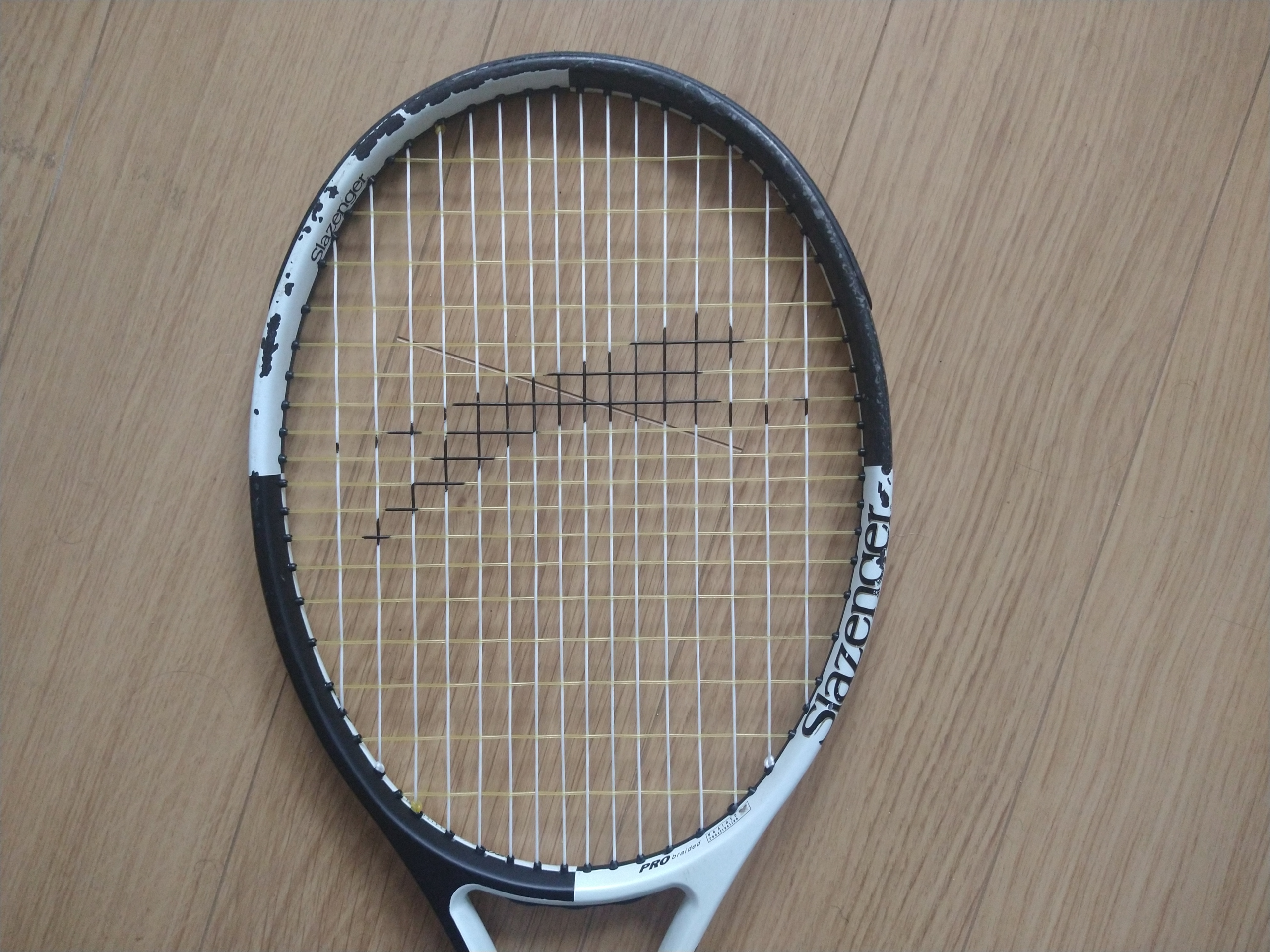
I’ve tried a lot of old rackets, and while it’s easy to get lost amongst a sea of classic frames that have built up over the years, it’s still possible to find something that stands out. Today it comes from an unlikely brand that’s been largely left behind: Slazenger.
The Slazenger Pro Braided 95 is a really interesting racket. I’ve always wanted one of these, not necessarily from being a fan of endorsee Tim Henman, but because Slazenger was such a dead racket brand by the time I started working on tennis rackets in the 2010s. As far as I could tell, the Pro Braided was their last success as a racket manufacturer (albeit small-scale), and I needed to see what it was like.
This racket was released in the late 90s, so reflects the serve & volley orientated game of it’s time, and is very clearly based on the popular Wilson ProStaff 6.1 95 (the 16×18 version, used by Henman before signing with Slazenger). The name “Pro Braided” even refers to the continuous braided frame construction of graphite & kevlar, which was also found in the Wilson ProStaff.
There are some key differences though: The Pro Braided is around 20 grams lighter than the rival ProStaff 6.1 (mine came in at 337 grams strung, with a leather grip) and once you get hitting you’ll immediately notice higher stiffness. A ProStaff would typically be in the 67-69 range on the RA scale, whereas the black-and-white Slazenger noticeably higher at around 73, according to Tennis Warehouse. Makes for some firm feedback.

Specifications
- Headsize: 95 square inches
- String Pattern: 16×18
- Mass (strung): 337 grams
- Balance: 31.5cm
- Stiffness: 73 RA
- Beam: 22mm constant
Armed with these specifications, the Slazenger Pro Braided absolutely shone at the net. The higher stiffness made it accurate and powerful when volleying, with the feedback sitting just right – not too harsh or unforgiving, but firm enough to get great directional control. The headlight balance and slightly lower twistweight (compared to a 6.1) means this racket is highly manoeuvrable, yet has just enough stability to cope with receiving faster balls at net.
But ultimately while oversized clothes may have come back for revenge from the 90s, the same can’t be said for serve & volley, and this is where the Slazenger Pro Braided gets left behind.
Playing from the baseline definitely felt like playing in handcuffs, particularly compared to modern rackets. Power is something the Slazenger lacked when driven further behind the baseline – I really felt I had to “muscle” the ball back into the rally at times, rather than loosen up and simply let the racket do the work. Even compared to other rackets of its era I would definitely have better picks for baseline play.
To be honest the Slazenger simply lacks the swingweight and forgiveness to endure at the baseline. Hitting heavy balls was a struggle on both serve and groundstroke in the tighter stages of a match, when you need to play and make some safer balls. With all the will in the world, mistakes on serve or dead groundstrokes with insufficient spin and power will creep in at times.

It can’t be overstated that this is is a frame that encourages you to attack and intimidate at the net. The Slazenger Pro Braided is one of the best volley rackets I’ve come across, albeit at the expense of a solid baseline game. But if you enjoy the chip & charge, serve & volley or simply throwing yourself around at the net, the Pro Braided should be on your “Must Try” list.
(I should note the handle feels a little larger than normal, so if you try to track down one of these rackets, I advise aiming for one grip size smaller than you are used to. Also the short handle mold means they definitely didn’t think of the two-handed backhand players out there!)
Leave a Reply