
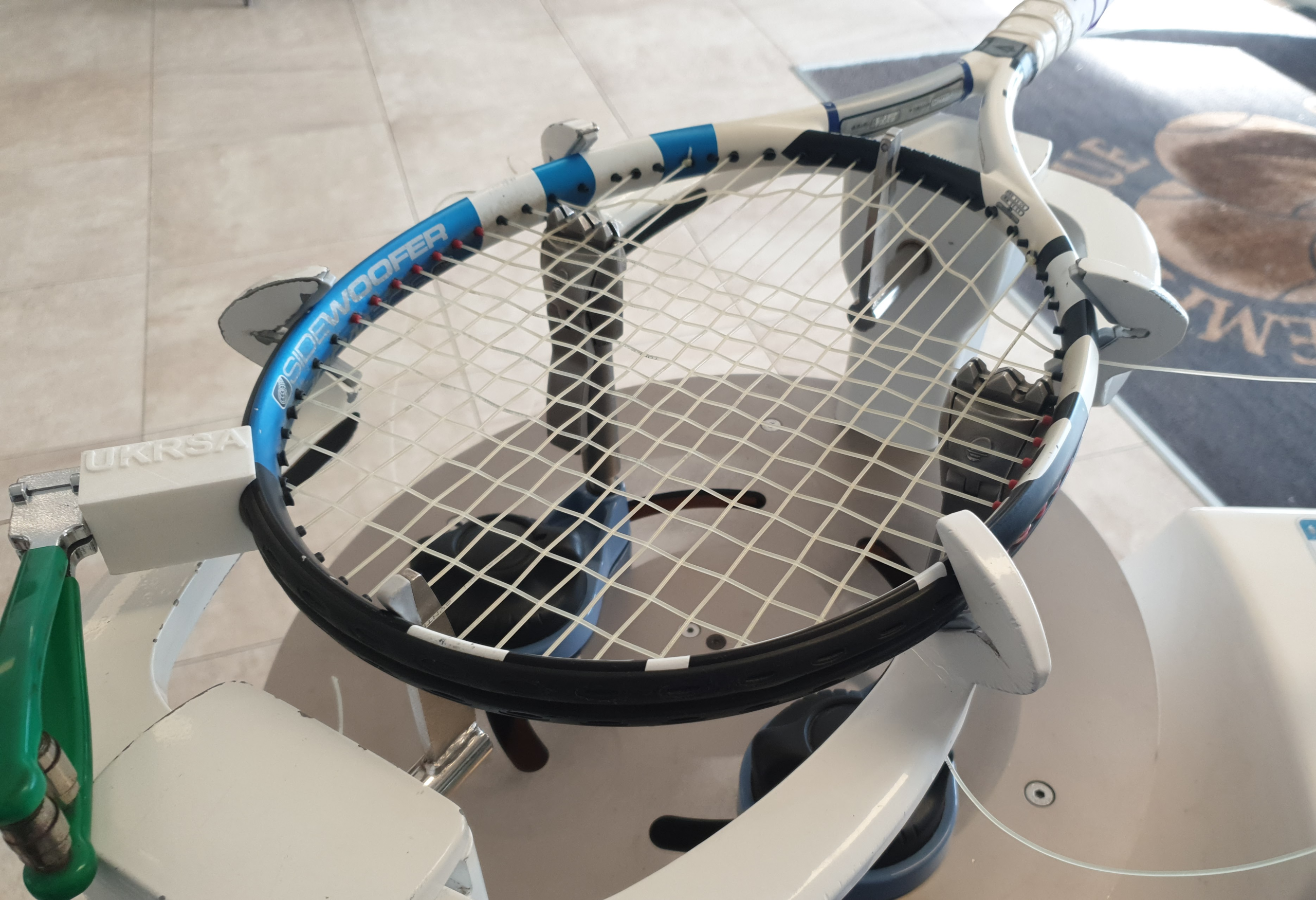
Apple versus Microsoft. Nadal versus Federer. Xbox versus Playstation.
The debate of One-Piece versus Two-Piece stringing probably doesn’t sit amongst these great topics of internet forum discourse, but it’s more important for the performance tennis player or aspiring racket stringer to know which method to choose.
In fact I’m going to save you some time: Two-Piece is better. Let me explain why.
In terms of technical differences, two-piece breaks down the stringing method into two stages and two separate lengths of string: One for the mains, one for the crosses, with four knots in total. Whereas, the one-piece method requires a single length of string and two knots. It’s fairly simple, however the complexity arises in the execution.
By and large, most rackets have the outside mains strings finish at the bottom (throat) of the racket, which is no problem for the two-piece method as you simply tie your two knots and complete the crosses starting from the top of the racket. However, to execute one-piece stringing in this situation, a more complex “Around The World” pattern is required, in which the outside mains are omitted and filled in later, such that the crosses can be strung from the top, down the racket.
This is where the issues arise. The crosses in a racket must be strung top-down, so ATW patterns are a bit trickier, meaning the result is I still see the occasional racket arrive into me with the crosses strung bottom-up, It’s easier, but has not been the industry standard of qualified stringers for many years.
Stringing the crosses bottom-up can distort the frame more, and is ultimately not how the manufacturer intended the racket to be strung. In fact some manufacturers require their rackets to be strung in two-piece. Prince O-Port rackets (throwback) were one of these, along with Yonex frames – in fact Yonex will void the racket’s warranty if they see it’s been strung one-piece at all.
This brings me to my central point: A correctly strung one-piece ATW pattern will not harm the racket, but much like Yonex, I see too many instances of one-piece patterns gone wrong to recommend players go out into the world and request their rackets be strung in the one-piece method. There’s too high a chance of one-piece being done wrong, and two-piece is far simpler to get right.
From the other side, as a stringer I am not particularly interested in doing one-piece patterns. I find measuring the long & short side and pulling through the extra length of string on said long side, is more time consuming and awkward. And when I’m staring down ten rackets to string, I like convenience and simplicity. Plus, the two-piece method brings up more options for a string setup. Differing tensions between the mains and crosses offers a different response and stringing in hybrid can totally change the playability of a racket also.
There is the adage of one-piece holding tension better, which I’ll entertain. The fewer tie-offs in one-piece theoretically reduce tension loss, but I will maintain that a properly strung two-piece pattern with good finishing knots will hold tension just as well.
Some stringers find one-piece faster, citing the fewer knots to tie and less string cutting, but assuming correct ATW technique, I put this in the same category as hearing of some stringers who find stringing on a mono clamp machine faster: At some point you just shut up and admire the work.
I’ll still do the odd racket in ATW/one-piece to upkeep my own skills, or perhaps if a racket’s tie off grommets are limited, or if the string loops are very fiddly with extra tie-offs involved, but two-piece will remain my standard.
Leave a Reply