
There’s nothing like Natural Gut. But we’re going compare the alternatives anyway.
Natural gut was the first “real” tennis string, originating in the early decades of tennis in the late 1800s, replacing the silk strings used in rackets at first. Babolat made their start here, producing natural gut strings for tennis rackets.
After more than a century full of technological improvements, natural gut still has it’s place in the tennis industry. No synthetic material has quite matched the elasticity, feel or even tension hold of the natural string, so the old-fashioned material still pops up in rackets belonging to Djokovic, Federer, Murray, Zverev and many others.
That being said, the string has some issues. Durability for one – particularly in this day and age in which the ball is being hit with more force than ever. In addition, dried cow intestines really don’t like moisture. Once the string gets in contact with damp, the fibres sort of unravel… which doesn’t make it much good for the average climate outside of California. Durability wouldn’t be such a huge issue if it weren’t for the sheer cost of the string. Anywhere from £40.00 plus for a set, before stringing fees!
That’s why multifilament strings are rather useful. They aim to mimic the properties of natural gut with synthetic materials, resulting in a higher durability and a lower cost. In my quest for an affordable substitute to the natural gut that constantly breaks in my setups, I’ve tested out a few strings.
Technifibre X-One Biphase is a popular alternative. It’s a great performance multi that turns up in all kinds of setups, and was even used by Novak Djokovic when he first hit the tour. This is a high-quality string produced in France that provides a great, crisp feel in finer touch. However at about £20.00 a set before stringing, it may be more cost-effective than real gut, but it’s not exactly cheap. And there was definitely a “harder” response than I got from gut, but thankfully there are plenty of gauges of Biphase to choose from, so there may be a way to fine-tune this.
While its somewhat boring, it’s worth mentioning standard synthetic gut also. These solid-core nylon strings are some of the lowest cost strings on the market at around £5-10 a set, but not all of them are created equal. My go-to synthetic guts are Prince Synthetic Gut and Toalson Synthetic Tournament for their made-in-Japan quality. These strings provide reasonable springiness, comfort and tension hold for the low price, and have good durability in the thicker 1.30-1.35mm gauges.
Prince Premier Touch is a unique string on the market. It’s spiral plastic ribbon construction and transparent colour makes it stand out amongst most strings, and this special design aims to mimic natural gut, which it absolutely achieves in terms of comfort. Premier Touch is one of the most forgiving strings I’ve come across, and provides good power from the back of the court. Its a must try for any arm injuries, however I found this string to lose tension fairly quickly so it may require regular restrings.
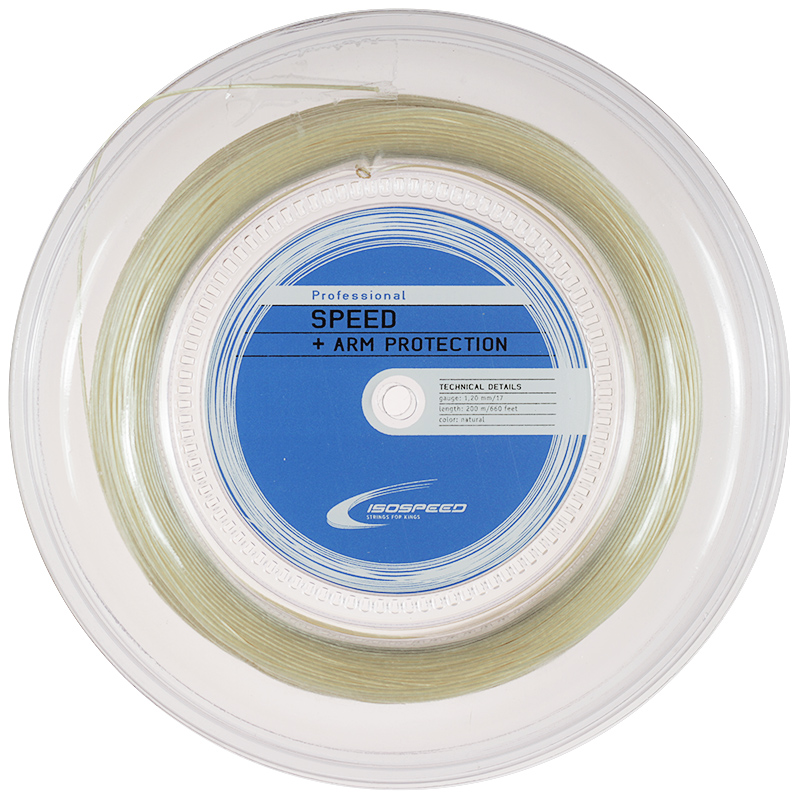
Isospeed Professional is a classic multifilament. Made in Austria and designed to compete directly with Natural Gut, this is another high performance multi made for, well, professionals. Former world no.1 Thomas Muster was best known for choosing this string over natural gut in the 80s. This string comes in 1.20mm as standard, providing good spin – particularly in a poly hybrid – but despite the thinner gauge, this string is surprisingly durable. My one hangup is the somewhat duller feel in comparison to real gut and it does lose tension over time.
Leave a Reply