
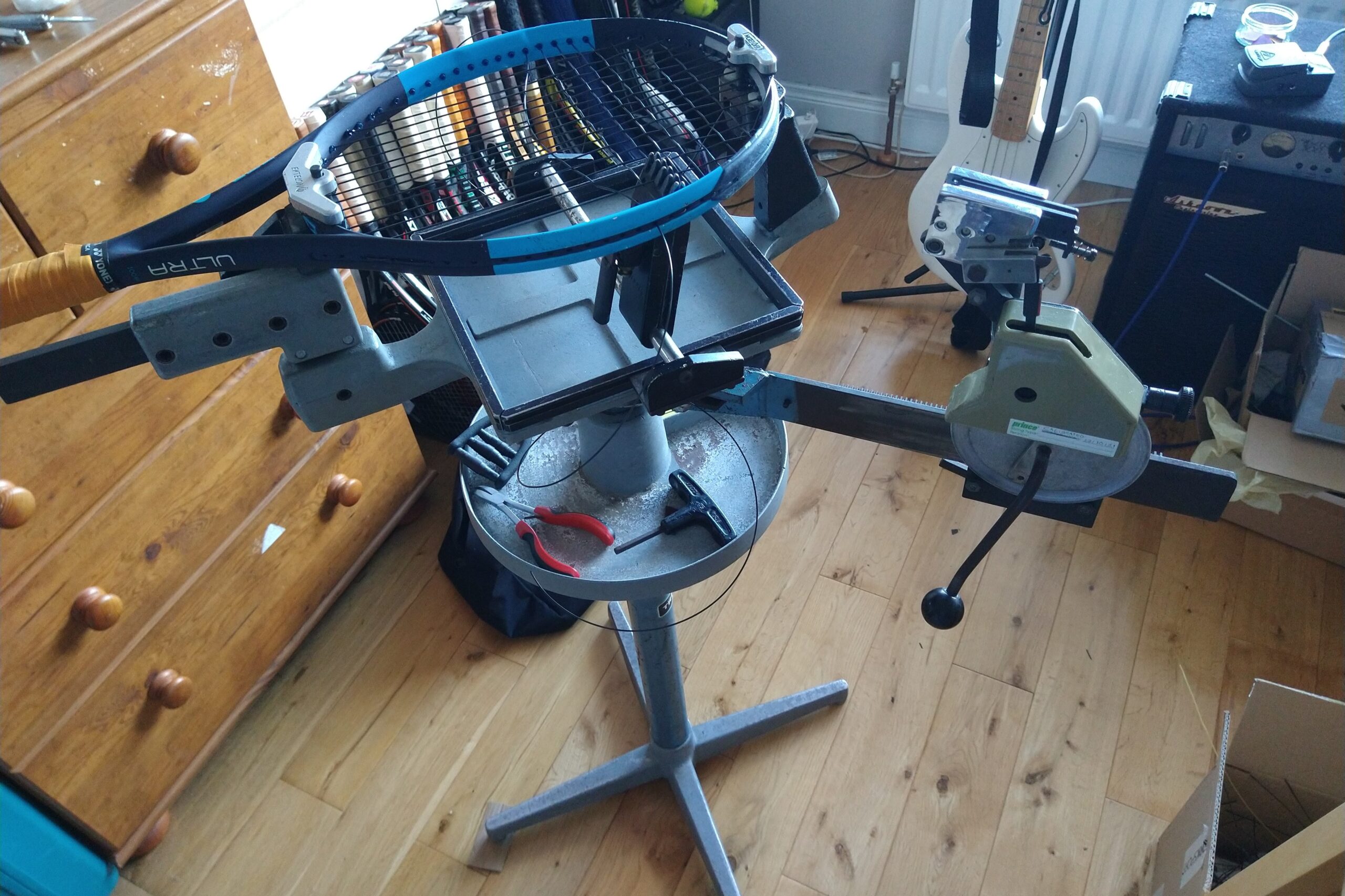
I string a lot of rackets, and believe it or not, I daily-drove a 1976 Ektelon Model D for quite a while. It certainly raised some eyebrows when other industry professionals asked which machine formed the backbone of my new stringing business, especially as we were well into the 21st century.
I had a more contemporary tabletop machine I’d worked on for years before, but I really wanted to get a freestanding machine as a spare, and maybe move into. Luckily, the recognisable Model D popped up just a few towns over… and for the low, low price of free.
I was in the middle of university and trying to get a racket stringing business off the ground, so pleasantly, this stringing machine actually fitted my budget. One man’s trash is another man’s treasure et cetera, et cetera. For this Model D, it was me or the scrapheap. Even if I had to track down and pay for a few extra parts to make the machine usable, surely it would be worth the hassle?

I picked up what remained of my Ektelon Model D from it’s original owner, who had stored it in his garage (must be nice) in the years after closing his sports shop. Although I didn’t get to ask too many details, I learned this machine cost him £1800 at the time of purchase! Nuts. Estimating a conservative purchase year of 1980, that’s almost £8000 in today’s money, after plugging the figures into an inflation calculator. Not far off the price of top-of-the-line electronic machines on the market today. Not that I was getting a direct competitor to the Yonex Precision 9.0 in the current day, but again, it’s hard to beat free.
Most of the original parts were there but irritatingly this Model D was missing the second glide bar. I could string on a mono clamp machine if I needed to, but if this was the case, I couldn’t exactly see myself using the Model D on a regular basis. The owner claimed his Model D only ever had the one glide bar, but I was suspicious of this given the box original parts I was given with it contained two matching pairs of badminton and tennis clamps. Hmmm. It’s not the kind of thing the manufacturer would include for a supposed mono clamp setup.
Regardless, this was a problem for later. It was miraculous the essential parts were largely still there after 40-50 years to begin with. Despite being stored in a damp garage in a damp country, without even a damp cover for protection, rust wasn’t much of an issue beyond some light surface oxidation.
The paint held up great over the decades, which I’ll chalk up to the legendary, handmade build quality of these machines. Some stringers who have been in the business longer than I, have said that not much has touched the build quality of the original Ektelon machines since, and I’m inclined to believe them. Granted, it meant actually lifting this solid lump of iron into the back of my Volvo was pretty difficult, but my ruined spine tells me it’s a quality item.

Before using this thing regularly, I also had to solve the racket mounting problem. The original Model D hit the market in 1976… and the thing about tennis in the 70s (as any older tennis club member tell you with some hubris) is rackets were still primarily made out of wood, and a lot smaller.
Therein lies a few flaws with the Model D. It’s not just compact, it’s rather small; and the menacing-looking steel mounts were designed to accommodate chunky, yielding wooden frames, plus maybe the odd steel or aluminium frame. Certainly not the comparatively brittle carbon rackets of 1980-something onwards. Moreover, even if I could work around the mounting surface problem, there was no chance of the lower racket clamp physically fitting around the larger throat piece of a modern frame.
Finding the parts I needed proved to be quite challenging. I thought obtaining a second glide bar would be easy; after all, the very similar Prince Neos 1000 (licensed by Ektelon back in the day) has the compatible parts I needed, but actually locating them was impossible. Nothing in Europe, not anymore. And while Tennis Machines in the US had the shiny new glide bars to make my dreams a reality, they were pretty expensive even before I tried to add the cost of shipping them out to Ireland.

So far, a free machine was proving pricey. I hoped getting new two point mounts would be possible through a stringer in the US who had been producing bespoke upgrade parts just for the Model D, demonstrated in installation videos that are still up on YouTube. However his website disappeared shortly after I obtained my Model D… I heard there was a fire at his shop, so sadly there would be no more parts. The narcissist in me would find this tragedy to be a personal inconvenience but I reckon I’m better than that.
Luckily for me, the algorithmic gods of internet shopping shone upon me and I snapped up a box of miscellaneous Ektelon parts on UK eBay for about £50, just two weeks after I first put my Model D in the boot of my car (it was still there since pickup, of course). What can I say, sometimes you get lucky and inflict a pile of forty-year old stringing machine parts upon yourself. At this point, I’ve almost got enough Ektelon parts to build myself a second Model D… not exactly my initial plan, but I’ll take it.
In addition to the solving the glide bar problem, the main reason I bought this parts lot was for the inclusion of two-point mounts from a later Ektelon Model H, which was produced a little later than the Model D and can therefore accommodate larger graphite frames, using a style of racket mount that is still used in the Neos 1000 to this day. Swapping the new racket clamps into the Model D body was simple – the parts drop into the original mounting points perfectly.

Fair warning to anyone thinking of picking one of these machines up: Yes, the handmade quality of the Model D is what kept it alive all these decades, but “Made in California in the 1970s” means every single nut, bolt and measurement on this machine is in imperial units. Not metric. A fact I discovered as soon as I tried to take it apart, and shortly before I made a trip to Halfords to purchase an imperial everything set. The costs of my little project had certainly gone up at this point, but I did get a lifetime guarantee with their “advanced” sets.

With all the pieces in place, and actually armed with the correct tools, I was in the final stages of setting up my acquired Model D. Layers of dust and the shrapnel of badminton rackets from decades past were removed, metal surfaces were polished and cleaned, the moving parts were adjusted and aligned to perfection, allowing the clamps to glide with ease. I went with the original tennis string clamps I received from the owner, as they had barely been touched since new, and besides, the teeth were narrow enough to fit around the badminton stringing patterns. I also switched out the original glide bar for two longer ones, to give me a chance to reach the end of the strings on longer rackets.
Unfortunately for me, one of the glide bars is starting to lose it stainless steel coating, which added some resistance to it’s ease of travel. I may have the stainless steel bars re-plated sometime, given the difficulty of obtaining anything other than thoroughly-used parts. I did need to fix and adjust the turntable brake as well, as one of the brake pads had long since fallen off, but lucky for me I found a spare amongst my treasure trove of Ektelon parts and mounted it with some double-sided tape. It’s been there a good few years now.
To sum up, there are pitfalls of picking up a stringing machine that’s nearly 50 years old, but with a bit of hard work, research and some luck, it is possible to get one of these back in functioning condition all these years later, and even ready for modern rackets.

Well…
It is certainly possible to string modern rackets with one of these, but after daily-driving the Model D for a few years, I’ll need to write a follow-up piece about how to work with it, getting into full detail about what it does well, and where it’s limitations arise.
Leave a Reply